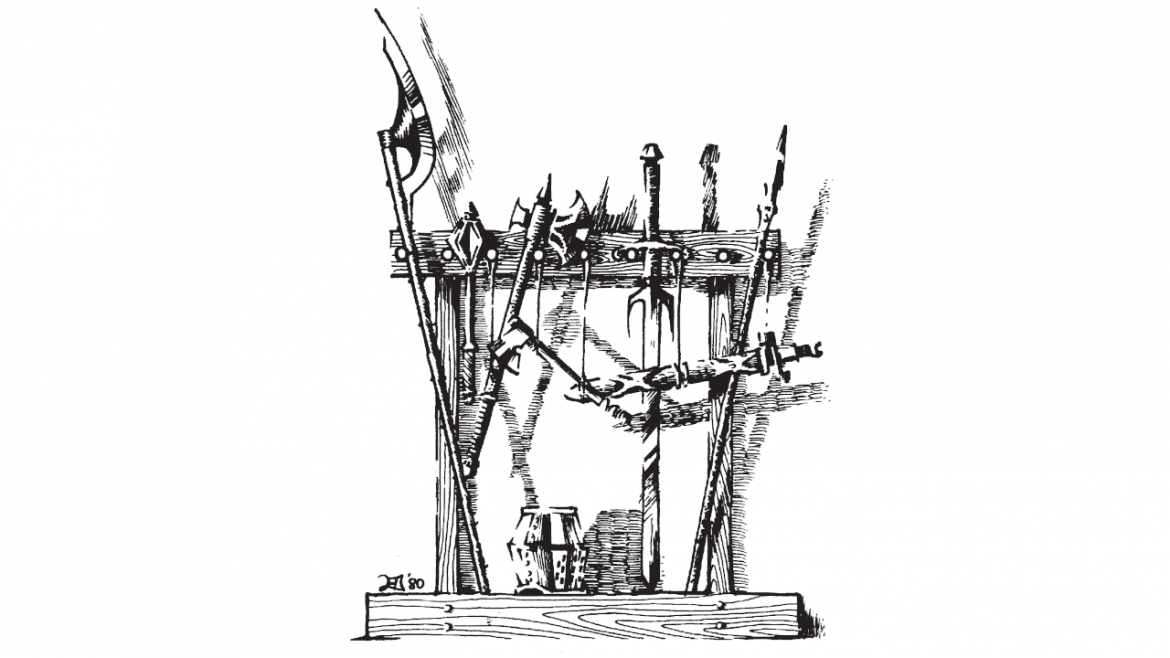
On Wandering DMs yesterday Dan and I were discussing the differences between OD&D and B/X and we got into the topic of equipment. Back in the day when I was running B/X regularly I realized that encumbrance info in B/X was lacking and was annoyed that equipment info is split up throughout the text in three different charts – costs, encumbrance, and damage. I created a unified table that I use regularly, but couldn’t find where it was on this blog. So off the top, here’s my current expanded B/X equipment tables.
But why was I looking for it? One of the interesting differences between OD&D and B/X D&D is the usability of equipment by race. This is perhaps extra important in B/X due to the race-as-class feature – you essentially have three variations of fighter in the game – fighter, dwarf, and halfling. Assuming the human fighter is the baseline, dwarves and halflings each blend in their own sets of benefits – infravision, extra languages, detection abilities, hiding, bonuses to saves, etc. To counter-balance this, there some requirements – minimum stats to qualify for these classes – and restrictions including level limit and inability to use large weapons.
In my own games I eventually house-ruled out race-as-class, detailed in the BXCL. I also got rid of the racial level limits, partly because I feel this is moot when you never actually play beyond 10th level, and ultimately I reused that restriction for multi-classing. This means when playing a single-class fighter, the only reason not to be a dwarf or halfling is the stat requirements. I don’t like the idea that this pushes high Dex/Con fighter types towards one of those choices – would you ever see a single-class human fighter with high Dex and Con?
I did add an XP tax in the BXCL – it costs 10% more XP to level up as a dwarf or halfling. I felt like this was a pretty good interpretation of the differences in the XP charts in B/X when using RAW race as class. That said, I think this cost is small enough that most players gloss over it very quickly. So that leaves us with the weapon limitation. According to the text, the only weapons off limits for dwarves and halflings is the long bow and the two-handed sword. Personally, I extend that include the pole arm as well, both because it seems logical, and I liked the idea that this leaves access to d10 damage weapons as a benefit to playing human fighters. But you have to give up your shield to get it, so when it comes to using a one-handed weapon, a normal sword is clearly the right choice regardless.
This has bothered me for a while, but I wasn’t sure what exactly I wanted to do about it. Finally, I made myself a quick chart of melee weapons grouped by number of hands required to use them and damage they do:
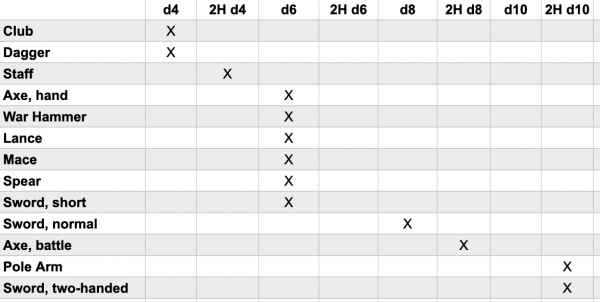
Honestly I came at this thinking the problem was the battle ax – it’s two handed and only does d8 damage. It is also the only two-handed weapon available to dwarves and halflings. But why on earth would you choose that over the obviously superior normal sword? It’s the only one-handed weapon that does d8 damage and it’s available to everyone.
So here’s another idea – what if I ruled that the normal sword is so big that dwarves and halflings can only wield it two-handed? For those classes this would mean the only way to get a d8 damage weapon is to choose a two-handed one: sword or battle ax. All the one-handed weapons (short sword, mace, war hammer, hand axe) are stuck at d6 damage. So as a halfling or dwarf fighter you can either wield a one-handed weapon for d6 damage or a two-handed weapon for d8. A human fighter now gets an interesting advantage – both categories get bumped up a die type with one handed d8 damage from a sword and d10 from two-handed swords and pole arms.
Another interesting side-effect here is that the short sword finally has a use case. Honestly, I can’t think of any reason in BX D&D that any character ever chose the short sword. The mace and hammer often get used by clerics as non-edged one-handed options, and the hand axe is often picked up as a throwable option by fighters. But the short sword? I honestly have never seen anyone choose it.
There is still part of me that wants to go fully abstract here as I did in the rules for Ten Dead Rats, where weapon stats are dictated by size. One handed “hand weapons” do d6 and two-handed “great weapons” do d8. The choice of what kind of weapon they are – sword, ax, club, table leg, whatever – is purely one of style. But I worry going too far off the deep end starts to break some of the nostalgia factor of this game for me, which is definitely one of the reasons I prefer playing BX over say any of the retro-clones.
So I’m writing this here to try it on for size – how do I feel about ruling that normal swords are two-handed for dwarves and halflings? Hmm… not bad honestly. Worth a try at least once I think. Though it doesn’t solve that pesky elf problem.

Paul,
Agree with the costs 10% more XP to level up as a dwarf or halfling. I looked up the BX rules for battle axe as I was surprised about the two-handed classification. I also looked up the Viking and English battle axe and saw that there were one- and two-handed battle axes. The one-handed axes were much bigger than the hand axe.
Yeah, I don’t think any other edition ever called the battle axe two handed, though by 3rd edition we start to see more variety of axes (EG the great axe).
” how do I feel about ruling that normal swords are two-handed for dwarves and elves? ”
Halflings?
LOL, yup! Thanks for the catch, fixing it now.
I do like it though, it gives a nod to the whole weapon size thing without becoming a whole subsystem.
This is a great way to read into some fine print.
I tend to avoid penalties especially those that don’t have much real value.
Perks are more acceptable, and the way to go is to give humans perks based on their class abilities.
Human fighters: an additional 1d4 hit points at first level, +1 bonus to to-hit, +1 to saves.
Human clerics: a 1st level spell at 1st level and +1 bonus to turn-undead rolls.
Human magic users: An additional spell at levels 1, 3, 5
Human thieves: increase all thief abilities by 10% or 15% – or perhaps only for 6 of them or such.
As for weapons: I see halflings being 2-handed with normal swords and the battle axe due to size.
I see Dwarves as doing 1d10 for 2-handed swords and such. Maybe give them a -1 penalty to to-hit rolls but I do not like penalties.
Instead, give human fighters a d12 rather than d10 for the 2-handers. In addition to the previous human fighter boons.
I also favor adding the flail (mentioned not statted out) along the lines of the hammer or mace; and 2-handed hammers, maces, and flails for Clerics and general use – for more variety. Keep it simple, for flavor without a great deal of number crunching.
Players tend to like perks better than penalties.
When people want to throw away weapons and armor restrictions, I do give magic users to-hit roll penalties for wearing armor (-1 leather, -2 chain, -3 plate, -1 for a shield) and likewise for using weapons other than daggers (i.e. -1 for d6 based, -2 for d8 based, -3 for d10 based). Yes, that seriously weapons damage for some weapons – your option might be to knock them down a die size: d6 damage based to to d4, d8 to d6, d10 to d8. As for magical weapons and armor, and magic users you face the same dilemma as a magic user getting those things and wanting to sell or trade them for staves, scrolls and such.
Thieves being a little simpler (chain -1, plate -2) plus a penalty to abilities when in chain or plat (-10%, -20%).
Clerics – depends on your ideas for restrictions due to deities demands and such.
I also prefer to consider staves as 2-handed and 1d6 damage (which makes the snake staff page B50 easier to explain), spears 1d6 when 1-handed or 1d8 when 2-handed, and so on.
Oops: “Yes, that seriously WEAKENS damage for some weapons -”
Everything is always imperfect.
Addendum: (posting software is so cranky) “I also favor adding the flail (mentioned not statted out) along the lines of the hammer or mace; and 2-handed hammers, maces, and flails for Clerics and general use WITH d8 DAMAGE -– for more variety. Keep it simple, for flavor without a great deal of number crunching.”
Days later and good sleep: The 2-handed battle axe at 1d8 is cheaper than a normal sword (7 gp vs 10 gp). To many people that is trivial. And to me that is the beauty of the 1981 D&D rules (B/X): they do not make everything so mechanically different that any one choice is an absolute must-have over another. Do you want a one-handed d8 axe? Simple: change the price to 10gp, call it a “war axe” or simething, and get on with play. If that is not enough then play AD&D or use its weapons or some similar game. I prefer imagination over statistics with a hint of variety; and yet see how others who prefer more mechanical variety can get that, too. For me, it is the simple variety that makes the game
fun. I say that while looking at house rules where I practically doubled the equipment lists with options and ideas. Not because it makes the game radically better, but because I have it ready-made when I get a hankering for it. I put together 8 PCs to play test some ideas and they are eauipped straight off the original equipmemt lists. But, if I want an orc with a two-limbed crossbow or hobgobs in scale mail for exotic variety – I got it covered.
P.S. I am not an edition war person. I like AD&D. And I like varying games for how they differ. I will play any game – if the people playing it are fun.